Not for the timid or easily offended...

Not for the timid or easily offended...
Is the FCC's "obscenity" obsession just a distraction from their promotion of Big Media Monopoly?

The STRANGE Cucumber radio show with DJ Stryder

Sunday Nights 11pm - 1am EST
WDCE 90.1 FM or streaming online
comments, contact or submissions:
email DJ Stryder any time or
IM during the show
stryderlee@gmail.com

Sunday, January 15, 2012

Of Communes & Drag Queens


This week's show will include two brief, unedited interviews. In the first half of the show we will hear from Kaya, a Richmond high school student who has spent two summers living and working at the Twin Oaks Community between Richmond and Charlottesville, VA. The community celebrated its 40th Anniversary in 2007 and was originally started by some psychology grad students inspired by B.F. Skinner's novel Walden Two.

Sandwiched between, we'll be hearing something new from Sidestep Complex along with my regular broad mix of music, audio collage, soundscape & live YouTube mixing.

In the second half of the show, just after midnight, I will play the first of my interviews with Richmond's famous "Dirtwoman" a.k.a. Donnie Corker according to his Wikipedia entry. Donnie has lived in Richmond for all of his 60 years and has established quite a reputation for himself, most recently he ran for Mayor in 2008. Be sure to listen in! The poster for his run for Mayor is adapted from a rare 1993 calendar shot by Alice McCabe and made in Richmond by the now defunct Hamlet Productions.

Donnie goofin' with new waitress at The Village Cafe
  

Tuesday, November 15, 2011

Why radio?


Radio pioneer Norman Corwin died at 101 this past October. A peer of radio journalist Edward R. Murrow, Corwin's broadcasting career spanned most of the 20th Century as well as a variety of genres. Known for his creativity and diverse writing talents, he helped compose "We Hold These Truths" a post-Pearl Harbor attack radio docudrama that featured Orson Welles, Jimmy Stewart, Edward G. Robinson, Lionel Barrymore and Walter Huston, and concluded with a live speech by FDR. 

During the brief documentary "A Note of Triumph: The Golden Age of Norman Corwin" he reminded us of the specific value of the medium of radio:

“In radio there was never a term equivalent to boob tube or couch potato. The eye is so literal, whereas the ear makes a participant of the listener. The listener becomes the set designer, the wardrobe mistress, the casting director. You can listen to ‘Carmen’ on radio. Carmen in person may weigh 350 pounds, but to the listener she’s a beautiful, steamy lady with a rose in her teeth.”


Tuesday, October 25, 2011

Apocalypse redux

Obviously I haven't been regular with this blog, but dammit, if that good old false prophet Harold Camping of Family Radio Ministry didn't goad me into an overdue entry when he revised his May prediction for the END OF THE WORLD to be October 21, 2011.  But maybe we shouldn't be surprised - his middle name is Egbert for godsake!

His delusional shenanigans would be amusing if not for the fact that there are plenty of other prophet-able end-times hucksters out there working overtime to connect current events with obscure bible passages. Are these folks much different than the 2012 Mayan calendar folk? Perhaps not, but at least the Mayan prophecy isn't a destructive judgement but rather a positive shift in human consciousness. In any case, it seems wise to be suspicious of all apocalyptic predictions - right Egbert?


Never underestimate the power of radio and a willing audience. 


Wednesday, May 18, 2011

The End of the World? (again)

A competition between dates for the end of the world?


In case you hadn't heard, the most recent prediction of the end of the world comes from Harold Camping, founder of Family Radio Worldwide, and it's going to be this Saturday May 21, 2011. So then, does that mean the apocalypse of 2012 is off?


Early Christians, and certain sects throughout history believed the end of the world to be imminent, but since the first century there have been dozens of failed predictions - maybe it's a Pavlovian thing. Eschatology certainly catches my attention. Camping's prediction has also been profitable for sign makers judging by the worldwide distribution of warning messages on billboards, posters and vehicles. 

Though the internet has undoubtedly helped Harold Camping disseminate his message, he has used radio to reach a worldwide audience for decades. According to Rory O'Connor in Shock Jocks, religious and other conservative radio programs have a 10-1 dominance of the airwaves over progressive or liberal radio programs and Camping was a pioneer in this growth. 

So, be sure to tune in this Sunday night to see if I'm still here - or to tell your own tale of disappearing Christians! 

Monday, April 25, 2011

OBEY

click the center of the pupil & adjust volume on right

In spite of our rhetorical litanies claiming to value free exchange, often our reality falls far short of this lofty and necessary democratic goal.  

"Be creative," "think out of the box," "we encourage free expression," "freedom of speech is important," in America we have a "free marketplace of ideas, "transparency of leadership," blah, blah, Blah, Blah, BLAH, BLAH! 

Too often we are subtly (and not so subtly) discouraged from thinking outside the confines of commercial programming, unregulated greed, plutocratic reverence, competition, prohibition, corporate personhood, academic values, departments,  rubrics, outlines, plans, hierarchies, trying to always control....but why?

"Control is controlled by the need to control."

Are a free exchange of ideas, promotion of creativity and leadership transparency really our daily experience? Sure, we don't (always) get clubbed, tear-gassed or shot with rubber bullets and hauled away to jail like people do in those "other" countries - but is that really the standard we want to measure ourselves by? 

Why smugly trumpet the values of creative free expression only to abandon them when we are bullied to do so? Sure, for survival, it can pay in the short run, but what about the bigger picture? Does history celebrate or even remember the timid and the tame? 

The heroes of history tend to be the heretics and the rebels, those who stand up to bullies, whose narrative  challenges the status-quo and who have the courage and support to relate that narrative freely (and who, we must admit,  often get burned in some way in the process).

...and if you think about it, human evolution happens because of mutation, deviance, difference, divergence - not just endless repetition of successful traits or formulas, no matter how tasty or fashionable!
could there be a connection?


Monday, April 11, 2011

mechanical metaphors


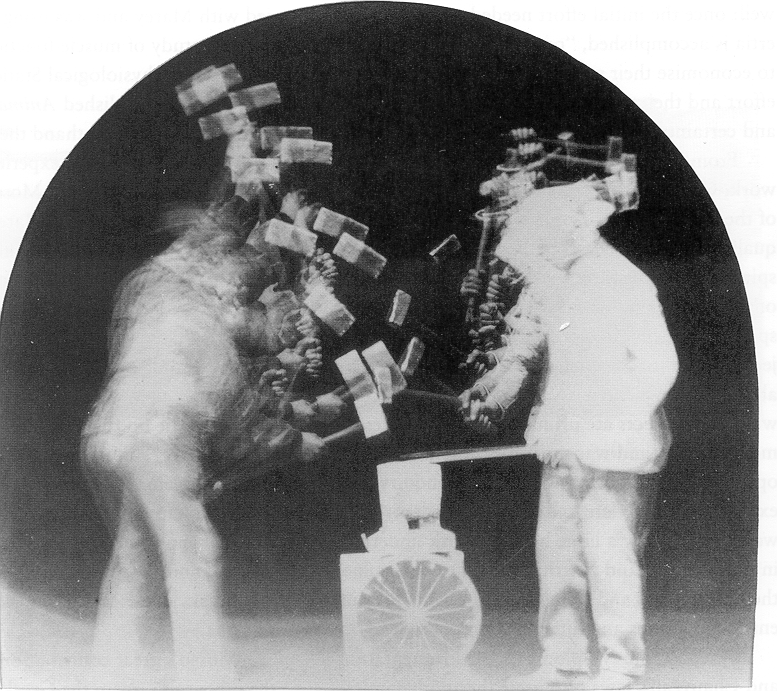
One of the thematic contrasts that recur in my show and in my thinking is that of the organic and the mechanical. The material wonders of industrial technology and mass production are ubiquitous and obvious, as is the praise for these pervasive systems but - our species seems to be losing touch with the natural and the organic and "nature deficit disorder" is on the rise. Outdoors, in the green woods we are confronted with the "chaos" of unsystematic Nature and must rely upon our own creativity and spontaneous action - there is no script. 


We regularly use machine metaphors to refer to the ideal in human performance and the digital world lures us into disdain for our bodies because they are never as "perfect" as our avatar - our bodies age and smell and this reminds us uncomfortably of our animality. Like D-503 in Zamyatin's We, our lives are increasingly lived within the comfortable confines of a "Green Wall" that keeps us safe from the chaos of Nature and encourages increasing reliance on the regimens of modern life. Though written in 1920, Zamyatin seems to capture our modern mania for hyper-scheduling and mechanical action. 


"But our Table of Hours! Why, it transforms each one of us into a figure of steel, a six-wheeled hero of a mighty epic poem. Every morning, with six-wheeled precision, at the same hour and the same moment, we—millions of us—get up as one. At the same hour, in millionheaded unison, we start work; and in million-headed unison we end it And, fused into a single million-handed body, at the same second, designated by the Table, we lift our spoons to our mouths. At the same second, we come out for our walk, go to the auditorium, go to the hall for Taylor exercises, fall asleep...."


We may not move as one for every task, but as humorously represented in the intro credits for Weeds, Americans do have recognizable robotic patterns.  As Malvina Reynolds' "Little Boxes" suggests, in some circles, the path of life is singular and prescribed - if they choose to follow the recipe given them.


"Little Boxes" by Malvina Reynolds (1962)


Little boxes on the hillside,
Little boxes made of ticky tacky
Little boxes on the hillside,
Little boxes all the same,
There's a green one and a pink one
And a blue one and a yellow one
And they're all made out of ticky tacky
And they all look just the same.

And the people in the houses
All went to the university
Where they were put in boxes
And they came out all the same
And there's doctors and lawyers
And business executives
And they're all made out of ticky tacky

And they all play on the golf course
And drink their martinis dry
And they all have pretty children
And the children go to school,
And the children go to summer camp
And then to the university
Where they are put in boxes
And they come out all the same.

And the boys go into business
And marry and raise a family
In boxes made of ticky tacky
And they all look just the same,
There's a green one and a pink one
And a blue one and a yellow one
And they're all made out of ticky tacky
And they all look just the same.


Thursday, March 31, 2011

Technology, Taylorism & Human Evolution


Considerations of the impact of industrial technologies are easy to find, but most of these are laudatory and generally focus on decreases in cost and increases in quantity, often overlooking the human impact and the significant problems that arise from uncritical overproduction - one of the specific critiques made in 1888 by Edward Bellamy in Looking Backward.

Early films like Fritz Lang's 1927 silent classic Metropolis demonstrate an early concern for the mechanizing impact of technology on human bodies as well as the efforts of owners to control workers via technological means. The contemporary relevance of Metropolis is suggested by its 2010 digital restoration.


Chaplin's semi-silent 1936 film Modern Times provides a more amusing reflection on the simultaneous mechanization of industry and man, as directed by owners and managers. Thought the film dialog could have been completely featured in sound, Chaplin choses to give only certain characters a voice - note who and reflect on the significance of this.


We've all enjoyed the bountiful (if often excessive) benefits of industrial production, but it's significant drawbacks have become normalized and its toll on us, invisible. As French philosopher Jacques Ellul notes in The Technological Society, the goal of technology is the precise, efficient result and the unpredictable embodied human must be subdued for this: "To the degree that technique must attain its result with mathematical precision, it has for its object the elimination of all human variability and elasticity." 


The connection to radio may be obvious, celebrating the variable and elastic nature of freeform radio, but a larger insight might be gained from brief reflection, at a greater distance, upon the history of our species. Technology has made our lives easier and more comfortable while simultaneously making us softer and less adaptable - and more rigid.

While forms, frameworks and systems are convenient technologies for organization and specific applications like mass production, they can become stifling bonds limiting creative exploration and problem-solving - like Blake's "mind-forged manacles" in his poem "Jerusalem."

While technologies have helped us to evolve, there may be a point at which our interaction with them is devolutionary, making us soft & unadaptable. Contemporary technological society requires increasing standardization and conformity on a variety of levels, but randomness, chance and mutation have been the drivers of human evolution - not predictable uniformity.

Monday, March 21, 2011

grassroots radio promotion

The useful "Best College Radio Stations" map in my previous posting is the work of a 26 year old radio activist and web developer named Sujay whose interest in the promise of non-commercial free-form radio was inspired by a move to the San Francisco Bay area where there are many creative, local stations ranging from KPFA's listener supported "free speech" radio at Berkeley to the more staid NPR clone KQED. 
When I asked Sujay what motivated his build of the site, he wrote "I've always sought out untainted sources of art and culture, and when I discovered college radio, I knew I found something great. I wanted an accessible map and playlist of the "best" stations and since I couldn't find them, I built them." 
When I asked whether the site included local community radio stations or if its focus was solely college radio. Sujay explained his rationale:"After initial research, it seemed like most 'community' stations relied on NPR broadcasts or were run by professional DJs.  I decided to limit the list to stations run by student volunteers. There are a lot of great stations that are not run by students, though, and that's why I'm working on a spin-off project right now that focuses on outstanding commercial-free radio shows from any station in the world."

This promising project may be part of the RADIOcollective grassroots work. From my brief email exchanges with Sujay, it seems that the value of promoting freeform radio is in its freedom for experimentation which is only possible with a freedom from regimentation. "To me, true freeform programming means that there are no rules. The DJ could broadcast static noise, satanic verses, or Top 40 hits. Obviously there are FCC guidelines, intellectual property restrictions, and hate speech regulations, but to me these are all forms of censorship."


Amen to that! In these days of homogenizing global consumer culture it is more crucial than ever to start creating our own. And when it comes to important issues, can't we find more serious moral considerations than whether or not someone has a potty-mouth?


Marlon Brando supplies a succinct analysis of our potty-mouth paranoia in his 
Colonel Kurtz monologue  from Apocalypse Now: “We train young men to drop fire on people but their commanders won’t allow them to write fuck on their airplanes because it’s obscene.” Is the broadcast of words like "fuck" and "shit" really a serious crime worthy of the significant legislative and enforcement costs involved? I wonder what the total annual cost would be?


Maybe the FCC's trivial obsession with taboo words is really just an effective distraction from their consistent promotion of media monopoly - just one more reason that grassroots radio is an increasingly important medium to use and support.

Sunday, March 13, 2011

Radio & Resisting Regimentation


The image above is a map of The Best College Radio Stations courtesy of DJ Sujay of Radio Collective whose mission statement is well targeted for the promotion of genuine cultural creations rather than the mechanically produced programming that is the law in commercial radio.

"We believe that independent radio is an unparalleled source of music and cultural exchange. Our goal is to discover and share the most interesting radio shows in the world, with the world."

In the homogenized wasteland of commercial radio, there is some small degree of "programming diversity" but the spectrum is surprisingly narrow considering how much lip-service we give in America to creativity and freedom of expression. 

Jordan Page, artist, activist and social commentator, writes about this narrow spectrum of programming in his brief, cleverly titled essay "Homogenization of Radio: Let us all give thanks and pay grateful homage to Clear Channel" 

 "There are many systems of control that shape our lives in this great nation we call America. They govern our daily lives on most fronts, our political and spiritual views, but it is undeniably more personal when they attack a people's access to art by filtering and bottlenecking anything that does not fit perfectly into the mold."

There are almost 20 "morning zoo" radio shows still being aired even though this trite format has been regurgitated since the 1980's when it was considered a fresh approach being promoted by broadcasters like Glenn Beck. If you listen closely to their script, you are sure to recognize the zoo litany. 


How many dithering duos start our days with their inane banter and canned station slogans like "the 50-minute music hour?" or "the workforce block?" The subtext suggested by such standardized professional programming rhetoric seems designed for distracting or mollifying legions of cubicle-bound workers.


More about DJ Sujay, the Radio Collective and the crucial need for truly independent "freeform" programming in my next post.

Monday, February 21, 2011

Strange Cucumber radio debut


Tonight is my radio debut as StryderLee hosting "Strange Cucumber" an eclectic, engaging, varied and unexpected radio show that combines music, audio collage, sound effects, commentary, spoken word, interviews, local soundscapes, interesting audio history and more. My first time slot is Monday mornings 1AM-3AM, a time when most folks are asleep but many college students are catching up on the studying they should have done over the weekend, so I hope I can engage them.

The origin of the title is in a remark one of my fellow students made to me one afternoon at the Eastern School of Farriery: "Stryder....you sure are a strange cucumber." An old friend gave me the name Stryder because I walk so fast, so I used it at horseshoeing school. The other guys taking the 6-week summer training course didn't know what to make of a guy who read books and didn't join in conversations about "niggers, faggots and bitches." When I tired of being kept up until 2AM (when we woke at 6 to work on horses!) I packed up and moved my gear from the men's bunkhouse (population 15) to the women's side (population 3) and these guys didn't know what to think - hence, "strange cucumber."

So, I hope the title doesn't scare anyone off and that for my two short hours I will be able to entertain, inform, provoke thought and surprise my listeners.

Friday, June 4, 2010

What is Noise?

After so long a break from my last entry, I plan to use my blog more for recording notes & my thoughts about sound and radio and the focus of my research rather than a daily or weekly (or yearly!) "posting."


In Ted Conover's recent NYT Book Review titled "Noises Off" he begins his review of three books about silence with a thought provoking question:
"So it might not surprise that a writer has just come out with a book about the problem of noise. But what does it mean that three have done so, within barely a month?" Conover follows up by noting that early in each book the writer details a sonic encounter that he admits has him nodding with sympathy as a fellow "noise crank." 

This phrase got me to thinking about my own annoyance with certain sounds like the ugly and ubiquitous leaf-blower, like some high-pitched banshee of our mechanical domination. The oddly droning screech of a leaf-blower can be heard a half-mile away, so then how loud is too loud?

If I can attach audio to this post, I'll upload a recording I made outside our home. We live on a hill on the south side of the James River just outside of Richmond, VA. This area is rich with wildlife and in the recording you can hear hawks and crows and cardinals, the distant roar of the river and.....
leafblowers, cars and trucks, jets, low-flying planes and helicopters.
It's SO peaceful here in the woods!

But those moments of silence in between the mechanical noises are as peaceful and uplifting as they could be. In such moments, the efficacy and necessity of such natural noises is clear. As R. Murray Schafer noted in his 1977 book The Soundscape we have become increasingly conditioned to, desensitized by and accepting of noise - and of the power it represents.
 
Jacques Attali discusses noise and power in his slim 1985 publication Noise: the Political Economy of Music, noting that it is power that gets to define what constitutes "noise" while also justifying its own expressions of sound. From the sonic sieges of Manuel Noregia and the Branch Davidian cult at Waco, the US Government has deployed sound as a weapon.

This fact might move us to pause and consider the impact of our own soundscapes on our physical health and emotional well-being. It may be that we are growing to need the sound of the machine and so experience great anxiety in the absence of mechanical sounds - but is this evolution?



Wednesday, November 19, 2008

a necessary collection


Recently I was honored by an invitation from the Richmond Amateur Radio Club (RARC) to speak about my research, and I think I've encountered a potentially important resource for my studies - and for our nation and local community.

Though I'm just beginning to learn about HAM radio and other 'old-school' radio technologies, it was immediately clear to me that in the audience of several dozen members who gathered for their monthly dinner meeting there was a collection of important technical know-how that should be gathered and digitally recorded for future operators.

In our digital age of Web 2.0 we tend to become so enchanted with new techno-toys that we dismiss, overlook or forget the power of more ancient and stable media like radio. Rather than discarding elder technologies and knowledge, we might more profitably compose a thoughtful hybrid of the new and the old. For example, on the Internet Archive website, you can type "amateur radio" in the search box and you'll find W2XBS George Bowen's "This Week in Amateur Radio # 735 with streaming audio news stories about the wisdom and utility of amateur radio during times of emergency.

How can we most powerfully combine radio technology with newer Web technologies? In his influential 1964 text Understanding Media, Canadian media theorist Marshall McLuhan notes how various "media...depend upon us for their interplay and their evolution" (73) and he observes the tremendous power unleashed by hybrid forms. The etymological root meaning of "hybrid" is fascinating: the offspring of a wild boar and a domestic sow - but which is the new tech and which is the old? McLuhan advocates "the hybrid principle as a technique of creative discovery." (80) Since most of the audience raised their hands when I asked who regularly got online to surf the Web, it may be that RARC members are already deploying hybrid media.

RARC's collective knowledge "amateur" radio technology is impressive, and important.
I'm hoping that, in the absence of a large audio archive project, RARC at least has an active mentorship program so that their knowledge can be passed on and we'll have it next time we're in trouble. In times of political, financial or weather emergency, amateur radio operators voluntarily form webs of communication that empower rescue and recovery when younger, more vulnerable technologies fail. While Katrina provided a notable example of this, many at the meeting had their own stories of disasters that they helped address via amateur radio networks. I'd love to get a few of those stories posted here!

Tuesday, November 11, 2008

power interference?

In the small window of opportunity allowed by the FCC for LPFM application, one of the objections made by corporate stations was that of interference. I'm not a technical expert, but I'm soliciting information from people who are like LBA Group, and I'll post it when it comes or you can post it here in the comments.

However, it seems that a small experiment is all the evidence I need to disprove corporate claims. Below is a brief audio of me trying to find WRIR 97.3 LPFM in Richmond, Virginia and it's clear that the station is not easy ot find, even with my RCA RP 7887 Super Radio. I have no problem receiving the station in my car, perhaps because the hood acts like a dish antenna, or maybe it's the digital tuner. In any case, as you can hear below, WRIR does not in any way interfere with the corporate stations that surround it on the dial. Corporate complaints don't stand up to a simple test - so why didn't anybody call their bluff?

(click radio tower image on left for my audio blog & the sound of corporate interference)

Wednesday, August 6, 2008

radio ROVE??


It may have been a nightmare, but I thought I had recently heard that Karl Rove was planning to start his own talk radio program - but when I googled the topic, I found no confirmation. However, I did find Rove's homage to Rush Limbaugh in which the conservative talk radio host is characterized as "educating, engaging and energizing" his listeners. Considering many of Limbaugh's "dittohead" fans pride themselves in their slavish repetition of his slogans we might challenge the educational impact of his show.

One point Rove may have is in acknowledging the excesses of "PC" culture, a point liberals should carefully consider. Promotion of tolerance and diversity is one thing but excessive management of language is always wrong and counterproductive - unless you live in Orwell's Oceania!

Though there have been some few liberal talk radio shows like Air America, they seem to have had far less funding and a smaller audience - why might this be so? In spite of the obsessive demonization of liberals, I find that there is very little evidence of an organized "Left" much less any liberal groups as venomous and extreme as those who demonize them. Have I missed the vast left-wing conspiracy? And if so, does the vast right-wing conspiracy still have any traction after so many years of historic incompetence, criminal activity and failed policies like media monopoly, privatization and corporate deregulation?

Monday, July 28, 2008

homogenization & hype

It is increasingly obvious that corporate media is vapid and bland, but this homogenizing influence - extending beyond simplistic 'content' - may require closer consideration.

A familiar echo of Huxley's "hypnopaedia" in Brave New World, nationwide repetition of calculated slogans and phrases works to discourage consciousness and support the
status quo.

Corporate radio programming is oriented towards an increasingly devalued "workforce" and is meant to remind us of our place in US plutocracy and how fortunate we are to receive the corporate blessing of a "50-minute music hour." It's not enough that corporations want to copyright our language, now they are redefining our measurement and experience of time.

Corporate media monopoly assures ongoing hype about the contributions to America that corporations have made, obscuring their 'externalized' costs while subtly implying that we could never live without them. A closer look at corporate history reveals a consistent pattern of greed, incompetence and crime - and massive public subsidy. Additionally, it is not hard to prove that corporate diversion of public funds is a central reason Americans don't enjoy the same level of social services as many other industrialized countries do. Non-commercial public access to broadcast media should be one of those subsidized social services as in the idea of a citizen run independent public broadcasting trust.

As a playful antidote and response to the dullness of corporate gruel, I'd like to invite participation in a little project. Inspired by Marshall McLuhan's audio collage "The Medium is the Massage," one of the projects I have in mind for my research is the composition of an audio collage of snippets from corporate radio stations all over the US - slogans, jingles, catchphrases...any of the hypnopaedic mantras repeated thousands of times a day on the airwaves. I would like to take these and compose them in an audio collage that will not only amuse, but powerfully demonstrate one problem with monopoly broadcasting.

Feel free to send me your suggestions & submissions!


Friday, July 25, 2008

LPFM no longer available?


One of the sources in my reading list is Radio Reader: Essays in the Cultural History of Radio edited by Hilmes & Loviglio (Routledge, 2002) and I recommend it as a useful and insightful survey of significant radio history from its early commercial take-over to its digital future.
One essay "Radio By and For the Public: the Death and Resurrection of Low-Power Radio" by Paul Riismandel is especially relevant to my focus on the history of WRIR.

From my reading so far it is my understanding that LPFM licenses are no longer available and are not likley to be in the near future - is this correct? Riismandel tells us that "religious groups received about half of all the LPFM construction permits" even though religious programming abounds on US airways. Is there a list of how the other permits were distributed?

Though opponents to LPFM claimed concern that it might interfere with high-power channels, this absurdity can be easily contradicted with an attempt to listen to Richmond radio stations. The corporate channels come screaming through loud and "clear" making WRIR sometimes difficult to detect amidst the corporate cacaphony.

And here's an LPFM technical question: I live in Stratford Hills, near Pony Pasture and I can receive WRIR quite easily in my car but in my home, even my new "Super Radio" is difficult to tune to its LPFM signal - why is this? Is there any way I can improve my reception in my home?

Sunday, July 6, 2008

Some Questions

So, as I pursue my research into radio I have a few preliminary questions that some of you might be able to answer...

What is the average cost to run a typical commercial radio station?
What about LPFM stations?
College radio stations?
Is there a text or source that could answer questions like these?

What is the basic minimum of equipment needed for an LPFM station to broadcast?
Approximately what would it cost?

What about radio in an emergency?
Could a radio station be run by a generator in a disaster?

Has the FCC stopped issuing LPFM licenses? If so, why?

Monday, June 30, 2008

now more than ever

This is my blog for collecting research, asking questions and pursuing my study of radio as part of my doctoral studies program. Even in this digital age, when we might be tempted to dismiss radio as 'old-school', we are use radio wave technology every day in our wireless devices, radio waves bring messages back from the Cassini-Huygens Saturn mission and in conjunction with the Web, even a small LPFM station can have a global reach.

I am interested in pursuing and promoting the experience of sound-without-image, deliberately and reflectively because I have a suspicion that in sound there are vast treasures yet to discover. More specifically I am interested in a revival of radio in the digital age, and even more specifically a revival of college LPFM stations and the deliberate promotion of 24-hour college radio programming all across the country.

a few of my reasons:
corporate radio is a wasteland of hucksterism, homogenization and sloganeering
radio is relatively inexpensive and reliable, especially in emergencies
youth voices are essential to democratic dialog & evolution
sharing of student-teacher collaborative research in well-designed programs